
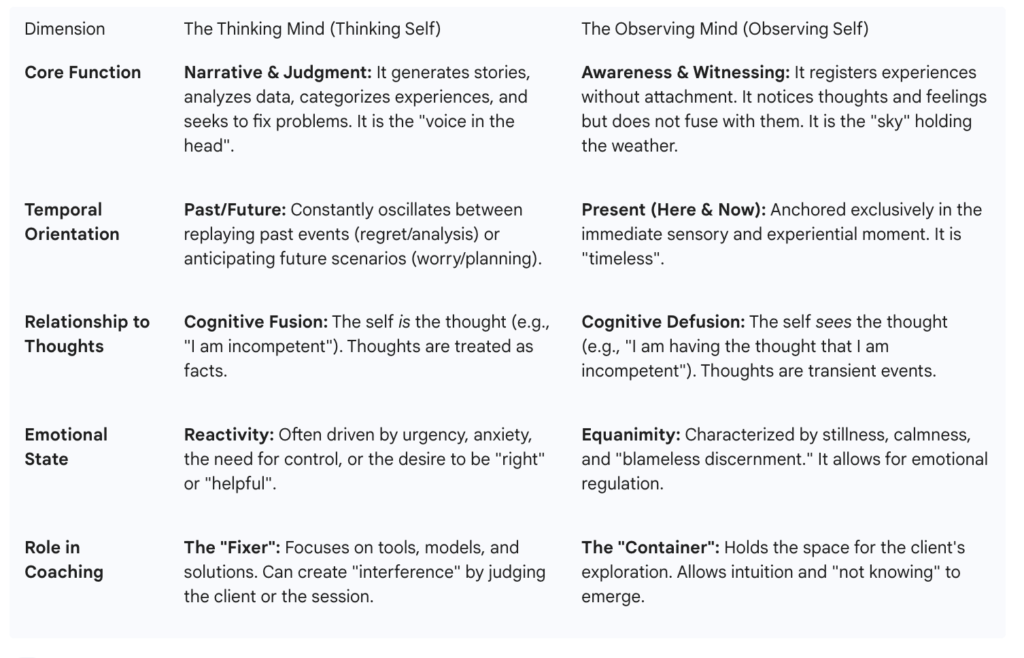
One of the most important (and often overlooked) distinctions in coaching is the difference between the Thinking Mind and the Observing Mind. The table above captures this contrast clearly and it explains why some coaching conversations feel rushed, solution-heavy, or emotionally charged, while others feel spacious, grounded, and transformative.
The Thinking Mind is the part of us that narrates, judges, analyses, and problem-solves. It is future- and past-oriented, constantly replaying what went wrong or anticipating what might happen next. In coaching, this mind often shows up as the “fixer”, often eager to offer tools, frameworks, or advice. While useful, it can unintentionally create interference by treating thoughts as facts and pushing for resolution before understanding has fully emerged.
In contrast, the Observing Mind operates from awareness rather than judgment. As shown in the table, it is anchored in the present moment, able to notice thoughts and emotions without fusing with them. This cognitive defusion allows both coach and client to step back from reactivity and access clarity. Emotionally, this state is marked by equanimity, displaying calmness, steadiness, and blameless discernment.
From a coaching perspective, the Observing Mind functions as the “container.” Instead of fixing, it holds space. Instead of analysing, it witnesses. This creates the psychological safety necessary for clients to explore their experiences honestly, regulate emotions, and arrive at insights that are internally generated rather than externally imposed.
The practical implication is simple but profound: effective coaching is not about eliminating the Thinking Mind, but about knowing when to step out of it.
When coaches cultivate their Observing Mind, they shift from doing coaching to the client, to being with the client. That shift is often where the deepest learning and change occur.
In short, the table is not just a conceptual comparison, it’s a diagnostic mirror. It invites coaches to ask: Which mind am I operating from right now, and what does this moment truly require?
Applying the Thinking Mind vs Observing Mind in Financial Coaching
In financial coaching, the Thinking Mind is often dominant and understandably so. Financial stress triggers urgency, fear, and a strong desire for certainty. Both clients and practitioners can slip quickly into analysis, numbers, action plans, and “what should be done next.” While technical competence is essential, over-reliance on the Thinking Mind can narrow the conversation prematurely.
When a coach operates primarily from the Thinking Mind, the session risks becoming transactional: budgeting fixes, repayment strategies, behavioural prescriptions. These are useful but incomplete. Clients may comply without truly engaging, or resist without knowing why. The emotional drivers behind financial behaviour remain untouched.
The Observing Mind changes the quality of financial coaching altogether. As reflected in the table, it introduces presence, cognitive defusion, and emotional regulation. Instead of treating thoughts like “I’m bad with money” or “I’ll never get out of debt” as facts, the coach helps the client notice these thoughts without being governed by them.
In practice, this looks like:
- Slowing the session down when urgency spikes
- Naming emotional states without judgment
- Allowing silence and uncertainty instead of rushing to solutions
- Holding space for shame, fear, or grief linked to money experiences
This does not mean abandoning tools or financial plans. It means sequencing them correctly.
The Observing Mind stabilises the emotional system first while the Thinking Mind then becomes a tool rather than a driver.
In financial coaching especially with vulnerable or debt-stressed clients, the Observing Mind functions as a stabilising container. It creates safety, restores agency, and allows clients to reconnect with their capacity to choose. Sustainable financial change rarely comes showcasing competence; it comes from cultivating clarity and self-trust.